Introduction
- TCP stands for ‘Transmission Control Protocol’.
Definition
- TCP is a reliable, secure, guaranteed, connection-oriented protocol of the transport layer of the TCP/IP protocol suite that provides in-order delivery of data.
Features
- A TCP protocol is called reliable because it guarantees that the data sent across the connection will be delivered exactly as sent (by the sender), without missing or duplicate data for the receiver.
- A TCP protocol is called connection-oriented because it requests and creates a logical connection between the sender and receiver first (before starting to send the data), and then uses it for data transfer.
- TCP has a 20-byte header (control structure).
- The DNS, HTTPS, FTP, SMTP, etc. protocols use TCP in their operations.
TCP Header/Format
- The TCP header (Transmission Control Protocol header) is a control information block that is added in front of the data before transmission to ensure reliable, ordered, and error-free communication between the sender and the receiver over a network.
- The minimum size of the TCP header is 20 bytes, but it can be extended using optional fields.
- The TCP header plays a crucial role in providing reliable data transfer, flow control, congestion control, and error detection in data communication networks.
- The structure of the TCP header is as follows –
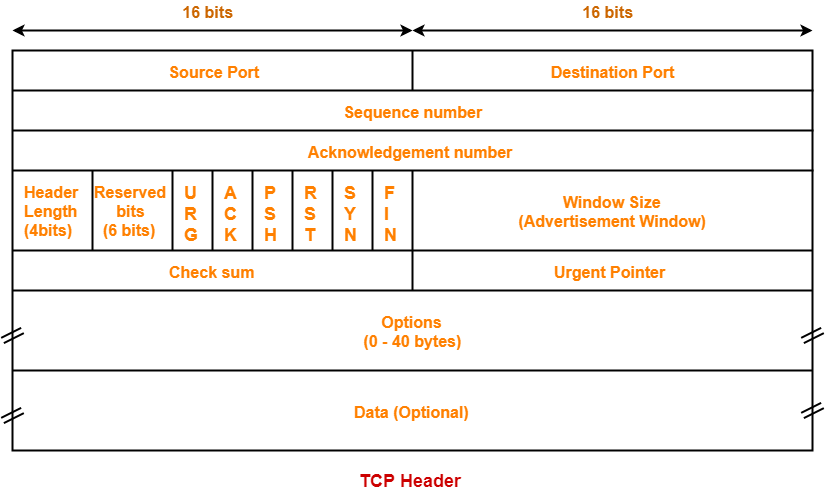
-
- Source Port
- This field identifies the port number of the sending application.
- Destination Port
- This field identifies the port number of the receiving application.
- These port numbers enable TCP to deliver data to the correct process at both ends.
- Sequence Number
- This field contains the number assigned to the first byte of data in the current segment, which helps TCP maintain the correct order of data during transmission.
- Acknowledgment Number
- This field indicates the next byte of data expected by the receiver, thereby confirming the successful receipt of previous data.
- Data Offset
- This field specifies the length of the TCP header and indicates where the actual data begins.
- Reserved Bit
- This field is kept for future use and is currently set to zero.
- Control Flags
- These bits (URG, ACK, PSH, RST, SYN, and FIN) are used to manage the establishment, maintenance, and termination of a TCP connection.
- Window Size
- This field is used for flow control and specifies the amount of data the receiver is willing to accept at a time.
- Checksum
- This field is used for error detection and ensures that the TCP header and data are not corrupted during transmission.
- Urgent Pointer
- This field indicates the presence and position of urgent data that must be processed immediately.
- Options
- This field allows TCP to support additional features such as Maximum Segment Size (MSS) and timestamps.
- Padding
- It is used to ensure that the header length is a multiple of 32 bits.
- Source Port
Advantages
- TCP is applied in Critical Applications processing.
- TCP supports the retransmission technology for lost data packets.
- TCP supports the Data Packet Reorder mechanism.
- TCP supports/use buffering and windowing mechanisms to implement the Data Flow Control mechanism.
- TCP supports an advanced error-checking mechanism.
- TCP supports the Acknowledgement mechanism.
- TCP supports the Handshaking(Three-way) mechanism.
Disadvantages/Limitations
- TCP is comparatively slower than UDP.

0 Comments