There are two famous working/functional & successful world-class and the most popular networking models –
[A] OSI Reference Model [B] TCP/IP Reference Model
Besides this, there were two outdated networking models: SNA and DNA.
[A] SNA Model
- SNA stands for Systems Network Architecture.
- SNA is one of the first formal network architectures.
- It was developed by IBM in the early 1970s to enable communication between IBM mainframe computers and their peripheral devices.
- SNA is a centralized network architecture in which a mainframe computer controls all communication in the network. The central host manages all data transfer, and network devices communicate through predefined paths.
- Features of SNA
- It is a proprietary architecture(a technology or system that is owned, controlled, and restricted by a single company or organization, i.e., a closed and vendor-controlled system) developed by IBM.
- It follows a hierarchical structure with a central controller.
- It provides reliable and controlled data communication.
- It is mainly used in mainframe and enterprise environments.
- It is a Mainframe-based architecture.
- SNA (Systems Network Architecture) is still used in a very limited way in some legacy IBM mainframe environments, especially in banks, insurance companies, and large enterprises that continue to run old but stable mainframe applications. However, even in these systems, SNA is often encapsulated over TCP/IP rather than used in its original form. It has been largely replaced by TCP/IP networks.
- Limitations of SNA
- It is complex and difficult to manage.
- It was less flexible than SNA.
- It is expensive to implement.
- It lacks flexibility compared to modern networks.
- It is not suitable for open, heterogeneous systems.
[B] DNA Model
- DNA stands for Digital Network Architecture.
- It was developed by Digital Equipment Corporation (DEC) in the mid-1970s to support communication between its computers and networking devices.
- DNA is a distributed network architecture, where network nodes can communicate more independently without relying on a single central controller.
- Features of DNA
- It supports peer-to-peer communication.
- It is a Node-based architecture.
- It is more flexible than SNA.
- It is designed for open and distributed systems.
- It supports multiple communication protocols.
- Limitations of DNA
- It is less commonly used today.
- It was mainly limited to DEC systems.
- It was more flexible than SNA.
- DNA (Digital Network Architecture) is no longer used today. It became obsolete after the decline of Digital Equipment Corporation (DEC) systems and has been completely replaced by modern networking standards. It is now obsolete and has been largely replaced by TCP/IP networks.
[C] OSI Reference Model
History
- In 1983 (in the early 1980s), the International Standards Organization (ISO) developed a model called Open Systems Interconnection (OSI).
- This model was developed after the TCP/IP reference model.
Introduction
- To send/receive and understand information in a computer network successfully, there exists a set of rules(TCP/IP) or standards (OSI) where standards ensure that varying devices and products can communicate with each other over any network. This set of standards is called a network reference model.
- There are a variety of networked models currently being implemented, but the OSI and TCP/IP models are important ones.
- Like the TCP/IP reference model, the OSI reference model is an open architecture/model, which means that it is publicly available, vendor-independent, and supported by many companies worldwide.
- The OSI model explains how communication should happen.
Definition
- The Open System Interconnection (OSI) model is designed as a theoretical network reference model which contains a set of protocols in their layered architecture that attempts to define and standardize(how data communications should take place) the data communications process in a network environment.
- The OSI (Open Systems Interconnection) model is a conceptual framework that standardizes the functions of a network communication system into seven distinct layers, each with a specific function, making network design, implementation, and troubleshooting easier.
- It is a standard reference model for OSI communication between two end users in a network to ensure interoperability and efficient data transfer.
Features
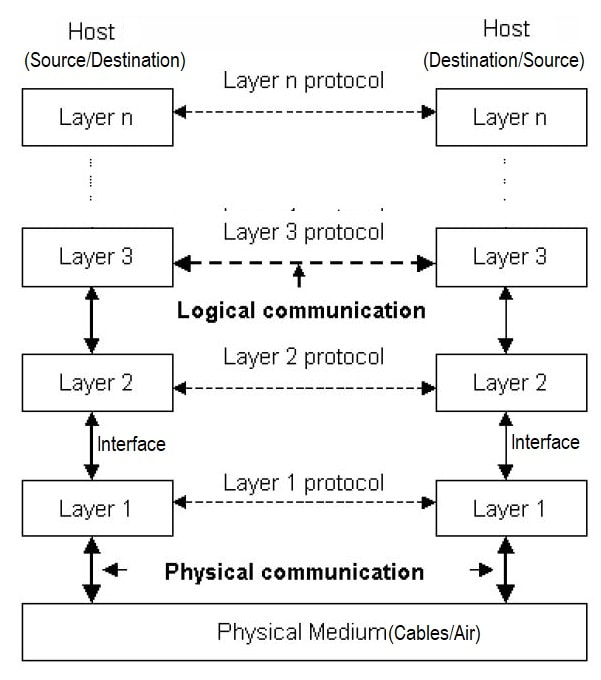
- Each layer of the OSI reference model is responsible for a particular aspect of data communication.
- Each layer has a set of specific functions that are to be performed by a specific protocol(s).
- The OSI model is modular, i.e., each successive layer of the OSI model works with the one above and below it.
- This model actually describes how information from a software application in one computer moves through a network medium to a software application in another computer.
- The OSI reference model has a protocol suite for all of its layers.
- This model is considered the primary architectural model for inter-computer communications.
- The OSI model has the support of most major computer and network vendors, many large customers, and most governments in different countries.
- The model is used in developing TCP/IP Models and understanding networks.
- This model is a prescription for characterizing and standardizing the functions of a communications system in terms of abstraction layers.
- Here, similar communication functions are grouped into logical layers.
- The OSI model divides the tasks involved with moving information between networked computers into seven smaller, more manageable task groups. A task or group of tasks is then assigned to each of the seven OSI layers.
- Each layer of this model is reasonably self-contained, hence the tasks assigned to each layer can be implemented independently. This enables the solutions offered by one layer to be updated without affecting the other layers.
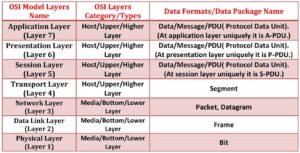
- Each layer of this model, except the physical layer, adds a few extra necessary pieces of information to the data as it travels from the Application layer down to the physical layer. This extra information is called Control Information in the header part of the transmitting unit. The physical layer does not append any information to the header because it is concerned with sending and receiving information on the individual bit level. Here, we see that the data for each layer consists of the header part and the data part of the next higher layer. Because the data format is different at each layer, different terms for the data part are commonly used to name the data package at each level.
-
In actual data communication, protocols do not start working all at once. They work in a layered order, and lower-layer protocols operate first, followed by higher-layer protocols. In data communication, lower-layer protocols such as Physical and Data Link layer protocols operate first to establish connectivity, followed by Network and Transport layer protocols, and finally Application layer protocols provide user services. Here, the bottom layers build the path, and the top layers use the path.
Types of OSI Reference Models
(A) Although each layer of the OSI model provides its own set of functions, it is possible to group the layers into two major, distinct categories:-
(a) The Host/Upper Layers :
-
- This layer includes the Application layer, Presentation layer, Session layer, and Transport layer.
- This layer focuses on users’ applications and how applications/ files are represented on the computers before being sent.
(b) The Media/Lower Layers :
-
- This layer includes the Network layer, the Data Link layer, and the Physical layer.
- The layer focuses on how the communication across a network actually occurs.
(B) The OSI reference model is further divided into two major categories based on data delivery –
(a) Data Processing Oriented Layers :
-
- The top three layers, i.e., the application, presentation, and session layers, provide the application services required for the exchange of information.
- They allow two applications, each running on a different node/machine of the network, to interact with each other through the services provided by their respective operating systems.
(b) Communication-Oriented Layers :
-
- The first four layers, namely the physical, data link, network, and transport layers, provide the end-to-end services necessary for transferring data between two systems.
- These layers provide the protocols associated with the communications network used to link two computers together.
(C) The OSI reference model is a conceptual model composed of seven layers, as shown below, and each layer specifies particular network functions.
(1.) Physical Layer (Layer 1)
(2.) Data Link Layer (Layer 2)
(3.) Network Layer (Layer 3)
(4.) Transport Layer (Layer 4)
(5.) Session Layer (Layer 5)
(6.) Presentation Layer (Layer 6)
(7.) Application Layer (Layer 7)
- The physical layer is responsible for the transmission of raw bits over a physical medium.
- It defines hardware specifications such as cables, connectors, voltages, and data rates.
2. Data Link Layer
- The data link layer ensures error-free transmission between two directly connected nodes.
- It handles framing, error detection, and flow control.
- The network layer manages logical addressing and routing.
- It determines the best path for data packets to travel from source to destination.
- The transport layer provides end-to-end communication and ensures complete data delivery.
- It handles segmentation, error recovery, and flow control.
- The session layer establishes, manages, and terminates communication sessions between applications.
- The presentation layer handles data formatting, encryption, and compression, ensuring that data is readable by the receiving system.
- The application layer provides network services to end users, such as email, file transfer, and web access.
Purpose of the OSI Model
- The main objectives of the OSI model are as follows –
- OSI provides guidelines and standards, but it is not widely implemented as a complete protocol stack.
- Its main role is to standardize communication concepts and ensure vendor-independent interoperability. OSI ensures interoperability between different systems and vendors in a network during communication.
- It helps in network design, development, and troubleshooting by isolating problems to specific layers.
- OSI separates network functions into distinct, manageable layers.
Importance of the OSI Model
- It helps understand complex communication processes.
- It enables the independent development of each layer.
- It serves as a teaching and reference model.
[D] TCP/IP Reference Model
- TCP/IP architecture is the universal networking standard used today because it is open, scalable, flexible, and supports heterogeneous systems.
- It was developed in the late 1970s and standardized in the early 1980s. DARPA created it.
- The TCP/IP model plays a practical and implementation-oriented role.
- It is the actual protocol suite used on the Internet. It defines real, working protocols such as TCP, IP, HTTP, FTP, and SMTP.
- It is fully implemented and widely used in real-world networks.
- Its main role is to enable real data communication over interconnected networks.
- The TCP/IP model explains how communication actually happens.
0 Comments